Rootworms and Refuges (1 Feb 2006)
While visiting with producers this fall we have noticed that there has been some confusion as to the new RW traits and refuge acres. It is very important that producers follow the refuge guidelines to prevent insect resistance to the traits. Planting a refuge is mandated by the EPA, is a contractual and regulatory obligation, works to preserve corn hybrids with the traits, and can be adapted to fit the way you farm. Hopefully this information taken from Pioneer will clear things up for you:
REFUGE PERCENTAGE
On each farm, plant up to 80 percent of corn acres with hybrids containing the YGRW gene. Plant at least 20 percent of the corn acres to a corn refuge that does not contain a Bt gene for control of western, northern, and Mexican corn rootworm.
DISTANCE REQUIREMENT
Plant the refuge within or adjacent to fields containing Bt corn rootworm protected hybrids. The corn refuge can be separated by a ditch or road but not by another field. Adjacent refuge fields must be owned or managed by the same grower. A neighbor's field cannot be used as the refuge.
INSECTICIDE USE
The corn refuge can be treated for corn rootworm larvae and other soil pests with soil-applied, seed-applied or foliar-applied insecticides. The refuge can also be treated with a non-Bt insecticide to control pests such as corn borer. However the part of the field containing hybrids with Bt corn rootworm protection must also be treated with insecticides for these pests.
REFUGE DESIGN
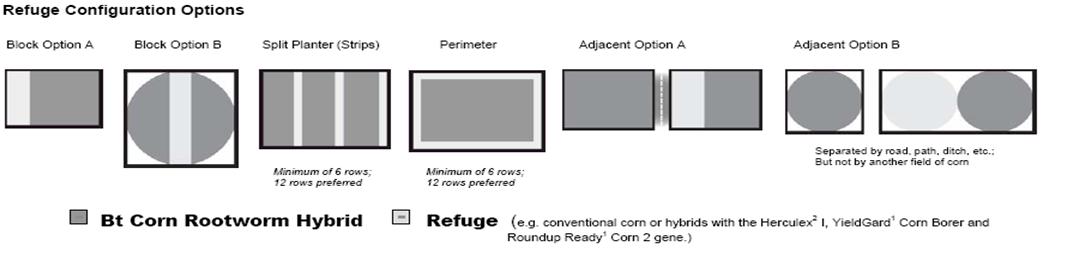
The refuge on each farm may be arranged in a number of configurations that allow the grower to easily incorporate an effective corn refuge into farm operations. Options include:
Plant the refuge adjacent to each cornfield containing hybrids with Bt corn rootworm protection.
Split the planter to alternate at least 6 consecutive rows (and preferably 12 rows) of refuge hybrids with hybrid containing Bt corn rootworm protection.
Plant field perimeters or end rows to a corn refuge.
REFUGE MANAGEMENT
Any corn hybrid that does not contain a Bt gene for control of western, northern and Mexican corn rootworm and is planted within or adjacent to the field containing Bt corn rootworm hybrids can serve as a refuge.
Þ Plant a refuge on every farm where corn hybrids containing Bt corn rootworm protection are planted.
Þ Plant the refuge hybrid(s) at the same time as the hybrids containing Bt corn rootworm protection.
Þ Manage refuge hybrid(s) and hybrid(s) containing Bt corn rootworm protection in a similar fashion.
Þ Plant the refuge hybrid(s) and the hybrid(s) containing Bt corn rootworm protection to fields with similar crop history. For example, if the field planted to corn with Bt corn rootworm protection was in corn the previous year, then the refuge must also be planted in a field that was planted to corn the previous year.
Þ Mixing non-rootworm resistant seed with seed containing Bt corn rootworm protection for use in the refuge is not permitted.
Þ Practice Integrated Pest Management (IPM) to preserve the natural enemies of corn rootworm and other insect pests. Natural predators such as ground beetles and ants can help reduce corn rootworm larval populations. Bt corn rootworm insect protection aids IPM because it affects only target insects and allows beneficial insects to thrive.
Þ Growers should monitor their fields planted to hybrids with Bt corn rootworm protection and contact their Pioneer sales professional if performance problems are observed.